Someone asked me today if blasphemy is an unforgivable sin.
And I wondered “What is blasphemy?” I remembered a moment as a 7 year old when I heard a boy in my class use a word with such emotional expression that I immediately wanted to say it to. It was in Afrikaans and sounded like “Gghhortt”. I have since heard “God” said with many other inflections. But never as guttural and expressive as then. But when I tried it on my teacher she let rip at me. Something in the Ten Commandments about ‘taking the name of the Lord in vain”. And I have carried this vague guilt about saying God’s name ever since. And have tried my best not to insult God again. But was this ‘blasphemy?’
So I looked up the meaning of the word. Blasphemy : it is a combination of two Greek words: blaptein, "to injure", and pheme, "reputation". And it is mostly used in connection with that which is holy. So blasphemy is to injure the reputation of God.
I do not believe that the Creator is in any way perturbed when someone uses the word “God” or “Jesus Christ” as an expletive. While this certainly shows lazy linguistic skill, it cannot dent the ego of God. It can, of course, be offensive to someone who respects God.
Similarly I do not believe that the Creator needs us to defend God’s honour. God is perfectly capable of self-defence. So when Salman Rashdie, or Dan Brown, offer ideas that are uncomfortable, they make people unhappy. But God is not perturbed by human opinions.
But I do see blasphemy:
* I see blasphemy in those who go to Church on Sunday, and then on Monday seek access to the world’s oil reserves through bullying, threats, and war.
* I see blasphemy in those who pray for God’s blessing before unleashing bombs that kill innocent people.
* I see blasphemy in people who use the name of Jesus to insult and denigrate those who are lesbian or homosexual.
And these are sins that will be hard to forgive. Because they claim to be done in the name of God. And as such they injure the reputation of God.
Thursday, October 19, 2006


Friday, October 13, 2006
Paraskevidekatriaphobia
 Fear of Friday the 13th is a pervasive superstition..This is the day that intersects both the unlucky number 13, and the unlucky day of Friday – a double whammy.
 Some tell of 13 being the number who sat down for the last (unhappy) supper with Jesus. But there are also much older stories of people being unable to count beyond 12 (ten fingers and two feet). Any number beyond this was the fearful unknown number full of vague and unimaginable possibilities - and therefore a number to be avoided by any peace-loving person.
As for Friday: Scandinavian mythology marks this as the day of Freyja, and as such was associated with the worship of Love. Fish was offered to this goddess, and love was made on Freyja day. As with many other customs "adopted" by Christians missionaries, ‘Freyja day’ is no different. Fish was accepted as the correct Friday diet. But the worship of Love on the Friday of each week was frowned on by the Church, who believed that mourning was the only appropriate response to the crucifiction day of Jesus. So what began as a celebration of love became an unhappy day instead. 'And on a Friday fil al this meschaunce,' wrote Chaucer in 'The Nun's Priest's Tale'.
Which is all bullshit as far as I am concerned. Because today is my birthday. I was born on October the 13th, and so far in my life I have experienced eight Friday 13th birthday celebrations. And they have all been very happy events. Today has been no exception. I had a very contended breakfast with my wife Jenny. I had an amicable lunch with my good friend Alex. I have had many, many happy SMS greetings and phone calls from friends. And I had a great supper at home with my family.
Of unlucky Friday 13th? Dicken’s Scrooge would have said “Bah. Humbug.”
Tuesday, October 10, 2006
Not a Church-goer
Yesterday I buried a good man. He had lived for 80 years, and died very suddenly of leukaemia. Here was someone who had started his own company and provided employment for many people in the garment-knitting industry. Someone who participated in Rotary for 35 years, organising major fund-raising events for scholarships for deserving children – for which he received the Paul Harris Award. Here is someone who gained his pilot’s licence so that he could volunteer to fly mercy missions for Red Cross. A man who is remembered by his children as one who paid attention to their lives and encouraged their dreams. His granddaughter spoke at the funeral of a Grandfather who taught her fishing, and gave advice on boyfriends and other important 12 year-old issues.
He walked on the mountains every Sunday morning. Sometimes instead of the mountains he would go to sea in his boat, or go into rough terrain in his 4X4 Pajero. This was a real man’s man, who gathered other men around him and inspired them to live life more fully. There were many, many men in church, attesting to this fact.
This man did not go to church. His wife did. And she asked if I would be willing to lead the funeral service. And I heard her apologetic tone that he had “not been a churchgoer.” As if not going to church was some shameful thing!
So here’s the thing: going to church does not qualify a person for anything. We are not better for being a church-goer; we are not wiser, or happier, or more loved by God. In fact I have met some of the most bigoted, spiteful, hateful, pompous people in church. And I know some of the most gentle, generous, compassionate people who have nothing to do with any church.
You see – I believe that God does not keep a register of “Sunday’s absent” from church. There is no heavenly reward for the number of hours given to church. Church is a human invention that meets a human need. And if it meets your need – then fine. But please do not feel guilty for not being a “church-goer”. What really counts is whether we have led lives that are Christ-like: Are we compassionate? Do we strive for justice? And do we show mercy?
Personally I believe that by collecting Christ-followers around me I will find courage when I am weak, and a place of accountability when I am arrogant. But the bureaucracy of organised religion, and the strutting of peacocks in clerical garb, and the blatant manipulation of people’s fears in order to keep bums on seats have nothing to do with Jesus. This is about the human attempt at control. And I want nothing to do with it.
So please bring the unchurched to be buried – and to be married, and encouraged, and to be blessed. I do not care if you are a member of a church or not.
He walked on the mountains every Sunday morning. Sometimes instead of the mountains he would go to sea in his boat, or go into rough terrain in his 4X4 Pajero. This was a real man’s man, who gathered other men around him and inspired them to live life more fully. There were many, many men in church, attesting to this fact.
This man did not go to church. His wife did. And she asked if I would be willing to lead the funeral service. And I heard her apologetic tone that he had “not been a churchgoer.” As if not going to church was some shameful thing!
So here’s the thing: going to church does not qualify a person for anything. We are not better for being a church-goer; we are not wiser, or happier, or more loved by God. In fact I have met some of the most bigoted, spiteful, hateful, pompous people in church. And I know some of the most gentle, generous, compassionate people who have nothing to do with any church.
You see – I believe that God does not keep a register of “Sunday’s absent” from church. There is no heavenly reward for the number of hours given to church. Church is a human invention that meets a human need. And if it meets your need – then fine. But please do not feel guilty for not being a “church-goer”. What really counts is whether we have led lives that are Christ-like: Are we compassionate? Do we strive for justice? And do we show mercy?
Personally I believe that by collecting Christ-followers around me I will find courage when I am weak, and a place of accountability when I am arrogant. But the bureaucracy of organised religion, and the strutting of peacocks in clerical garb, and the blatant manipulation of people’s fears in order to keep bums on seats have nothing to do with Jesus. This is about the human attempt at control. And I want nothing to do with it.
So please bring the unchurched to be buried – and to be married, and encouraged, and to be blessed. I do not care if you are a member of a church or not.
Thursday, October 05, 2006
The Bible as Sacred Myth

I believe the Bible to be myth… sacred myth. Before you get the wrong idea, read the following extract from Karen Armstrong’s “A Short History of Myth" (Edinburgh; Canongate Books 2005)
Today the word ‘myth’ is often used to describe something that is simply not true. A politician accused of a peccadillo will say that it is a myth, that it never happened. When we hear of gods walking the earth, of dead men striding out of tombs, or of seas miraculously parting to let a favoured people escape from their enemies, we dismiss these stories as incredible and demonstrably untrue. Since the eighteenth century, we have developed a scientific view of history; we are concerned above all with what actually happened. But in the pre-modern world, when people wrote about the past they were more concerned with what an event had meant. A myth was an event which, in some sense, had happened once, but which also happened all the time…mythology is an art form which points beyond history to what is timeless in human existence….a myth, therefore is true because it is effective, not because it gives us factual information….if it forces us to change our minds and hearts, gives us new hope, and compels us to live more fully, it is a valid myth.
I am totally frustrated with people who want to reduce the Bible to factual information. And then they try to ‘prove’ selected texts as historical fact. Much of the Bible was never written as fact. It was written as myth. It was intended to transform the lives of those who encountered its stories. I absolutely believe the Bible – as the sacred myths that guide my life. And in choosing to believe, I have found challenge, transformation, and new hope.
Sunday, October 01, 2006
Francesco di Bernardone 1182 - 1228
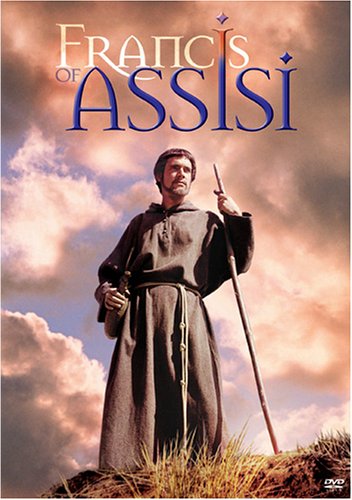 He is one of the heroes of my faith. A man who voluntarily chose to challenge the prevailing culture of the day, and has left an indelible mark on history. Today is the feast day of Francis of Assisi, who was instrumental in founding the monastic Orders of the Poor Clares and the Friars Minor.
 He gathered a group of people around him who were committed to a life of apostolic poverty. This meant letting go of the need for possessions, choosing to share the gospel of Jesus from the perspective of the poor, and emphasising the love of God for all of creation. Everyone was a brother/sister, and all of creation was to be treasured. Francis challenged his culture’s obsession with clothing as a sign of status, and possessions as a sign of achievement. And Francis brought a compassion for the poor, the forgotten and the ignored.
Francis had his blindnesses: he was anti-Muslim and pro-Crusades. In 1219 he helped the Crusaders capture Muslim-held Damietta in the Holy land. The man who created the great prayer for peace was unable to see his part in creating violence! What makes him my hero is this blend of both greatness and fallibility. Greatness is not about being perfect. Greatness is the ability to keep the vision alive – despite the personal flaws.
A man like Francis gives me hope that I might be able to hold to a Godly vision despite my personal flaws. Please pray for me.
Wednesday, September 27, 2006
Of Mixed Parentage
South Africa has just marked “Heritage Day” – a day where we as a nation celebrate our rich diversity of culture and history. And I am part of this diversity:
My Paternal Ancestors came to South Africa from Germany, landing in Mossel Bay in 1870. (I Googled my name and “bingo” I have a namesake in Germany today). They soon moved to Outshoorn and became Afrikaans. One of their children then moved to Cape Town, and rejected learning Hooghollands in favour of English. So on my Father’s side I am German/Afrikaans/English.
My Maternal Ancestors were the English aristocracy of Cape Town. Ralph Henry Aderne had sailed from England on the “Eliza” at the end of 1830. Add to this my Grandfather’s passion for anything Scottish, and a Kilt of the Ancient Frasers inherited through his mother, and I am English/Scottish.
I can chuck in some interesting relatives like Mary Arden, the mother of William Shakespeare; Dr James Arderne, personal chaplain to King Charles II; David Philip of publishing fame; Rev Ernest Lasbrey, rector of St John’s parish for approximately 40 years; ethnomusicologist Andrew Tracey, Captain Hurrell of the Salvation Army began the Mission to Seamen in Simonstown, Ruth Grassow represented South African bowls at the Olympics; and Margaret Lasbrey played Springbok hockey. And then there are some maiden aunts and cousins that we do not mention in polite company – oh yes there is the uncle who faked his own suicide in order to escape his creditors, only to be discovered in a bar in Bulawayo some years later.
What does this really prove? Nothing at all – and everything. I am of a mixed background: German and English in my veins, Scottish and South African to the core. Add to this the fact that I was born in Mthatha in the Transkei; I have lived in a “coloured” township for 10 years of my life; I was part of the South African Military; I joined the UDF and played tennis for SACOS; and I currently live with neighbours who are Muslim, Afrikaans, English, German and Jewish.
I love this country. And I love its diversity. I am not white, or black. I am not English or Afrikaans. I am neither European nor Xhosa.
I am a South African.
My Paternal Ancestors came to South Africa from Germany, landing in Mossel Bay in 1870. (I Googled my name and “bingo” I have a namesake in Germany today). They soon moved to Outshoorn and became Afrikaans. One of their children then moved to Cape Town, and rejected learning Hooghollands in favour of English. So on my Father’s side I am German/Afrikaans/English.
My Maternal Ancestors were the English aristocracy of Cape Town. Ralph Henry Aderne had sailed from England on the “Eliza” at the end of 1830. Add to this my Grandfather’s passion for anything Scottish, and a Kilt of the Ancient Frasers inherited through his mother, and I am English/Scottish.
I can chuck in some interesting relatives like Mary Arden, the mother of William Shakespeare; Dr James Arderne, personal chaplain to King Charles II; David Philip of publishing fame; Rev Ernest Lasbrey, rector of St John’s parish for approximately 40 years; ethnomusicologist Andrew Tracey, Captain Hurrell of the Salvation Army began the Mission to Seamen in Simonstown, Ruth Grassow represented South African bowls at the Olympics; and Margaret Lasbrey played Springbok hockey. And then there are some maiden aunts and cousins that we do not mention in polite company – oh yes there is the uncle who faked his own suicide in order to escape his creditors, only to be discovered in a bar in Bulawayo some years later.
What does this really prove? Nothing at all – and everything. I am of a mixed background: German and English in my veins, Scottish and South African to the core. Add to this the fact that I was born in Mthatha in the Transkei; I have lived in a “coloured” township for 10 years of my life; I was part of the South African Military; I joined the UDF and played tennis for SACOS; and I currently live with neighbours who are Muslim, Afrikaans, English, German and Jewish.
I love this country. And I love its diversity. I am not white, or black. I am not English or Afrikaans. I am neither European nor Xhosa.
I am a South African.
Monday, September 18, 2006
God Botherers
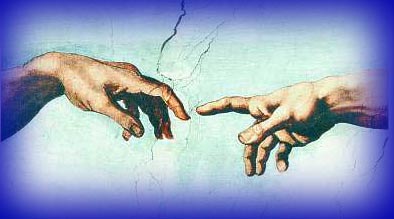 Too much of our praying is ineffectual God-bothering. We act as if God is ignorant of our lives and has to be reminded of the God-tasks that need to be done:
“Lord – give me…”
"God – please bless….”
"Lord – bring peace to ….”
As if God is unaware of the human need!
Of course God hears the cry of the broken hearted, and the groan of the oppressed. But these cries for help can never be instructions to a forgetful God. If God is not aware of the things we need, or if God does not know about injustice and pain that need God-like intervention, then this is a distracted and inattentive deity. For God to be God, the Divine Spirit should be aware of everything we need before we speak the words.
Which brings us closer to what prayer should be. Prayer is the moment of our silencing; it is the moment of the intervention of the Divine into our brokenness and need; it is the place of silence where the Spirit engages our spirit. Anything else is God-bothering.
And in our silence is the possibility of hearing the promptings of the Divine. Here is space for the One who fills all space to engage our lives. And here is opportunity for us to respond to the call of the Other. Good prayer is when we get off our knees to offer service to other people.
I have just spent a week in prayer: some of which was my own cry for attention. And then there were those rare moments in the silence where I discovered the Divine whisper. A nudge to become more intentional about my passions. So look to this blogspace to see signs of me shedding my middle-aged disengaged cynicism, and retrieving some of my former radicalism.
Monday, September 11, 2006
Praying
 I am off to a Benedictine Monastery for a week of prayer. I am privileged to share this with three caring friends - Kevin, Dion, and Peter. The gracious monks of this place of prayer have allowed us to (briefly) share their life of prayer.
This monastery is perched on a hillside just outside Grahamstown looking down a valley of bushes and trees. The monks ring the bell for communal prayer (5 times a day). In between these times we will be silent. I hope to use this as a time listening to the heartbeat of the Universal Creator of Life. And of reflection.
Pray for me.
Thursday, September 07, 2006
I do not want Someone dying for my sins!
I have made many mistakes in my life.
- Sometimes I was curious. And having tried something out of curiosity, I discovered that it was not good for me. And I learned from this, and grew in another direction.
- Sometimes I was selfish, and believed that my own needs should take precedence over others. And I have discovered in the pain of hurting those I love, a motivation to change my ways.
- Sometimes I chose to do nothing, and experienced a moment of cowardice, or a moment of selfish reluctance to assist someone. And I learned from this to be more participative in life.
- And then there were moments when I knew something to be wrong, but I did it anyway. I did it because I was angry, or I was frustrated, or I was just bloody minded. And I have lived to regret my actions. And learned to think more carefully before I just moer on with my own course of action.
 Each of these moments was an opportunity to learn more about living life, and a moment of spiritual maturing.
And so I continue to learn about life – mostly through my mistakes and my selfish impulses. But these are my moments. I own them. And I find it preposterous that I should be punished by God for them! How else do I learn about life? I find it even more preposterous to think that God would both love me, yet need to klap me for my mistakes.
One Church Father tried to explain that God is both perfectly loving, yet perfectly just. Therefore, because God’s justice needed to punish someone, God’s love chose to kill Jesus instead of me. So how is justice enhanced by the death of a person? There is no opportunity for people to learn from their mistakes. One strike and you’re out! And anyway, killing the one person who was sinless is a travesty of justice, not a triumph of good.
This belief has nothing to do with God. It is a belief born within a culture of avenging crimes. If God is a loving Parent, then surely God would understand when I make a mistake? Surely God would encourage me to learn from it. I often imagine God saying to me “Ja, you stuffed up. Now try again”.
So I do not need someone to die for my sins. I am willing to take my chances with God for my mistakes. And more than willing to answer for my own actions.
- Sometimes I was curious. And having tried something out of curiosity, I discovered that it was not good for me. And I learned from this, and grew in another direction.
- Sometimes I was selfish, and believed that my own needs should take precedence over others. And I have discovered in the pain of hurting those I love, a motivation to change my ways.
- Sometimes I chose to do nothing, and experienced a moment of cowardice, or a moment of selfish reluctance to assist someone. And I learned from this to be more participative in life.
- And then there were moments when I knew something to be wrong, but I did it anyway. I did it because I was angry, or I was frustrated, or I was just bloody minded. And I have lived to regret my actions. And learned to think more carefully before I just moer on with my own course of action.
 Each of these moments was an opportunity to learn more about living life, and a moment of spiritual maturing.
 And so I continue to learn about life – mostly through my mistakes and my selfish impulses. But these are my moments. I own them. And I find it preposterous that I should be punished by God for them! How else do I learn about life? I find it even more preposterous to think that God would both love me, yet need to klap me for my mistakes.
One Church Father tried to explain that God is both perfectly loving, yet perfectly just. Therefore, because God’s justice needed to punish someone, God’s love chose to kill Jesus instead of me. So how is justice enhanced by the death of a person? There is no opportunity for people to learn from their mistakes. One strike and you’re out! And anyway, killing the one person who was sinless is a travesty of justice, not a triumph of good.
This belief has nothing to do with God. It is a belief born within a culture of avenging crimes. If God is a loving Parent, then surely God would understand when I make a mistake? Surely God would encourage me to learn from it. I often imagine God saying to me “Ja, you stuffed up. Now try again”.
So I do not need someone to die for my sins. I am willing to take my chances with God for my mistakes. And more than willing to answer for my own actions.
Monday, August 28, 2006
An Act of Penance
The Sunday Argus reported that Adrian Vlok, the former minister of police during the days of Apartheid, visited Frank Chikane and asked his forgiveness for the past. He then took some water and washed Chikane’s feet as an act of penance.
What I found intriguing is that the newspaper chose to describe this as a “bizarre act of penance”. Which part was bizarre: washing feet, or saying sorry? I suspect that what this reporter found strange was the idea of saying sorry when there was no incentive to do so. It is too late for the Truth and Reconciliation Commission, and too late to avoid prosecution is the State chooses to do so. I suspect that the TRC has conditioned us to the idea that confession is rewarded. I suspect that we have also become used to the idea that confession is a prerequisite for forgiveness.
I came across the following quote by Robert Farrar Capon in the blogspot of Dave Lynch (http://gardenofrenown.blogspot.com) that makes sense of this for me:
In respect to the parable of the Prodigal Son...
Peter Woods would say that this is a perfect example of the unconditional love of God. Perhaps we should be learning more about forgiveness before confession!
What I found intriguing is that the newspaper chose to describe this as a “bizarre act of penance”. Which part was bizarre: washing feet, or saying sorry? I suspect that what this reporter found strange was the idea of saying sorry when there was no incentive to do so. It is too late for the Truth and Reconciliation Commission, and too late to avoid prosecution is the State chooses to do so. I suspect that the TRC has conditioned us to the idea that confession is rewarded. I suspect that we have also become used to the idea that confession is a prerequisite for forgiveness.
I came across the following quote by Robert Farrar Capon in the blogspot of Dave Lynch (http://gardenofrenown.blogspot.com) that makes sense of this for me:
In respect to the parable of the Prodigal Son...
The fascinating thing also is that when the father embraces the boy who has come home from wasting his life, the boy never gets his confession out of his mouth until after the kiss, until after the embrace. What this says to you and me who have to live with the business of trying to confess our sins is that confession is not a pre-condition of forgiveness. It’s something that you do after you know you have been forgiven. Confession is not something you do in order to get forgiveness. It’s something you do in order to celebrate the forgiveness you got for nothing. Nobody can earn forgiveness. The Prodigal knows he's a dead son. He can't come home as a son, and yet in his father's arms he rises from the dead and then he is able to come to his father's side.
Peter Woods would say that this is a perfect example of the unconditional love of God. Perhaps we should be learning more about forgiveness before confession!
Saturday, August 26, 2006
The Mission Field Too
To continue from my last blog:
You know – the one about the ordination service?
Well the venue was too small for the event. The pushing, the shoving, and the downright duplicity displayed by people grabbing at seats was reminiscent of the soccer hooligans that get arrested by the police.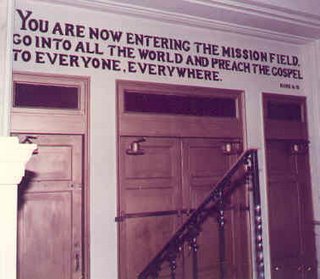 This was not done by people of another faith. This was the red, black and white uniformed members of the church. The seats were reserved, and tickets were issued. These faithful, but unticketed, members shoved their way in and plonked their bums on the reserved seats. When a plea was made for those without tickets to leave their seats, no one stirred. And people with tickets were shut outside.
Over the exit of this church is a sign informing us that on leaving we are “now entering the mission field”. This sign is profoundly wrong. The mission field is sitting in the pews of the church.
You know – the one about the ordination service?
Well the venue was too small for the event. The pushing, the shoving, and the downright duplicity displayed by people grabbing at seats was reminiscent of the soccer hooligans that get arrested by the police.
 This was not done by people of another faith. This was the red, black and white uniformed members of the church. The seats were reserved, and tickets were issued. These faithful, but unticketed, members shoved their way in and plonked their bums on the reserved seats. When a plea was made for those without tickets to leave their seats, no one stirred. And people with tickets were shut outside.
Over the exit of this church is a sign informing us that on leaving we are “now entering the mission field”. This sign is profoundly wrong. The mission field is sitting in the pews of the church.
Friday, August 25, 2006
Go and read...
Tony Yengeni - Gus says it well so go check him out: www.gruntle.co.za
What an individual can do about making a difference - Jan is doing it: www.heart2heart.blogspot.com
What an individual can do about making a difference - Jan is doing it: www.heart2heart.blogspot.com
Wednesday, August 23, 2006
Unordained
Last weekend I attended a national gathering of my church. It was an ordination service – a consecration of people to ministry within my corner of the Christian faith.
I found myself amongst my colleagues. Here, amidst the greetings and the reunions, I discovered our deconsecration. We were the Presbyters – those appointed to lay hands on the Ordinands. But in between laying on hands and taking Holy Communion we spent the afternoon comparing financial statistics and numerical attendance; we dropped names and compared influence; we gossiped shamelessly; we wore the clothes of royalty, and left the event in cars of luxury. And I felt……deconsecrated.
Today I found another pastor who is as distressed as I am: Eugene Peterson, writing in Working the Angles, tells of pastors who have become
You see – I discover these things in my heart too. I am seductively distracted by these things. But I am determined to be different. I see how this church is turning me into something that I do not want to be. And so if being an ordained minister is about church politics, status and power, then I do not want this. So I hereby declare myself ‘unordained’…..cut off from this kind of church practice.
But there is a glimmer of hope: those who made their ordination vows last weekend bring a breath of fresh air with them. I celebrate new colleagues such as Ecclesia, and Hilton, and Delm. They seek to be different. And I look to them to keep reminding me that the pastoral ministry is a response to the call of God, and not of this deeply flawed institution. Pray for me, that I may respond to life with a God pleasing integrity.
I found myself amongst my colleagues. Here, amidst the greetings and the reunions, I discovered our deconsecration. We were the Presbyters – those appointed to lay hands on the Ordinands. But in between laying on hands and taking Holy Communion we spent the afternoon comparing financial statistics and numerical attendance; we dropped names and compared influence; we gossiped shamelessly; we wore the clothes of royalty, and left the event in cars of luxury. And I felt……deconsecrated.
Today I found another pastor who is as distressed as I am: Eugene Peterson, writing in Working the Angles, tells of pastors who have become
"a company of shopkeepers, and the shops they keep are churches. They are preoccupied with shopkeeper's concerns--how to keep the customers happy, how to lure customers away from competitors down the street, how to package the goods so that the customers will lay out more money. Some of them are very good shopkeepers. They attract a lot of customers, pull in great sums of money, develop splendid reputations. Yet it is still shopkeeping; religious shopkeeping, to be sure, but shopkeeping all the same. The marketing strategies of the fast-food franchise occupy the waking minds of these entrepreneurs; while asleep they dream of the kind of success that will get the attention of journalists”.
You see – I discover these things in my heart too. I am seductively distracted by these things. But I am determined to be different. I see how this church is turning me into something that I do not want to be. And so if being an ordained minister is about church politics, status and power, then I do not want this. So I hereby declare myself ‘unordained’…..cut off from this kind of church practice.
But there is a glimmer of hope: those who made their ordination vows last weekend bring a breath of fresh air with them. I celebrate new colleagues such as Ecclesia, and Hilton, and Delm. They seek to be different. And I look to them to keep reminding me that the pastoral ministry is a response to the call of God, and not of this deeply flawed institution. Pray for me, that I may respond to life with a God pleasing integrity.
Saturday, August 19, 2006
Bikers are Players
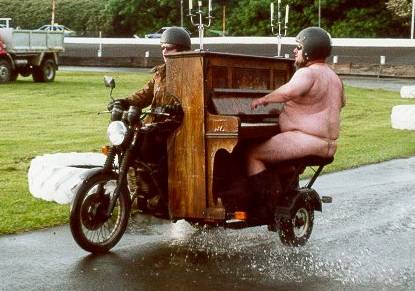
In my last blog I noted my appreciation for “Men who had decided to set aside the cares of their lives and play a bit”. Well here is a player to be admired for his courage under fire. I suspect that all the lunatic, laughable, joyous moments in life are the work of the Creator. And I sense the Creator enjoying this moment.
Tuesday, August 15, 2006
Smelling the Viscera
 Biking evokes all the senses of the body.
My motorcycle leads me to discover the joy of feeling alive in ways that are beyond reason. Biking is visceral. It touches the intestines - the stuff of feeling, and emotion and passion.
I was reminded afresh of this on Sunday.
I met with seven other two-wheeled enthusiasts just outside Port Elizabeth. We did the usual dog-like thing of sniffing around each other bikes to see whose arse sat on what size engine. And then we were off – howling down the highway testing the early morning air. This sunshine-warmed air soon gave way to the chilly Gamtoos valley, where we stopped to pee in the river. Then on through farms that exuded the distinctive smell of cows, followed by the fresh sea air of Cape St Francis. This section of the trip concluded itself with the smells of bacon, egg and sausage. And as we sat around the table I enjoyed the visceral passion of seven other men. Men who had decided to set aside the cares of their lives and play a bit.
And I sensed the Creator playing along with us: a Being who had sent a variety of sensory experiences our way. And I was content.
Friday, August 04, 2006
The Gods are Dying
The gods are dying. The gods of this world are sick unto death.
Which gods? The gods that we worship. The gods that our enemies worship. Their sacred names? There is Science, for one: he who was to redeem the world from poverty and disease, on whose mighty shoulders mankind was to be borne onward and upward toward the high stars. There is Communism, that holy one so terrible in his predilection for blood sacrifice but so magnificent in his promise of the messianic age: from each according to his ability, to each according to his need. Or Democracy, that gentler god with his gospel of freedom for all peoples, including those people who after century of exploitation and neglect at the hands of the older democracies can be set free now only to flounder in danger of falling prey to new exploiters. And we must not leave out from this role of the dying what often passes for the god of the church; the god who sanctifies our foreign policy and our business methods, our political views and our racial prejudices. The god who, bless him, asks so little and promises so much: peace of mind, the end of our inferiority complexes. Go to church and feel better. The family that prays together stays together. Not everybody can afford a pyschiatrist or two weeks of solid rest in the country, but anybody can afford this god. He comes cheap.
These are the gods in whom the world has put its ultimate trust. Some of them are particular gods, and there are plenty of others, each can name for himself. And where are they now? They are dying, dying, and their twilight thickens into the night. Where is the security that they promised? Where is the peace? The terrible truth is that the gods of this world are no more worthy of our ultimate trust than are the men who created them.
And where are we? Stripped of our securities and bereft of our man-made gods, we stand as lonely and hypnotized spectators at the dance of death as it is being played out in our time. With the gods that we have created all going or gone, soon all that may remain is the God who created us, brooding over our darkness.
The former things are passing away and the gods are dying, just as the former things must pass away and the gods must die so that the new things can begin to come to life beneath the dark wings, so that creation can go on happening. My question is this: Are there in us, in you and me now, that recklessness of loving heart, that wild courage, that crazy gladness in the face of darkness and death, that shuddering faithfulness even unto the end of the world, through which new things can come to pass?
If not, God have mercy upon us, for we will soon be as yesterday when it is gone. If so, then we, even we, will have some part in the new heaven and the new earth the God is creating.
Excerpts from the second chapter of Frederick Buechner's book entitled "The Magnificent Defeat"....and thanks to the guys at www.stupidchurchpeople.com for taking me to this. If you have not visited this site then I recommend that you do.
Which gods? The gods that we worship. The gods that our enemies worship. Their sacred names? There is Science, for one: he who was to redeem the world from poverty and disease, on whose mighty shoulders mankind was to be borne onward and upward toward the high stars. There is Communism, that holy one so terrible in his predilection for blood sacrifice but so magnificent in his promise of the messianic age: from each according to his ability, to each according to his need. Or Democracy, that gentler god with his gospel of freedom for all peoples, including those people who after century of exploitation and neglect at the hands of the older democracies can be set free now only to flounder in danger of falling prey to new exploiters. And we must not leave out from this role of the dying what often passes for the god of the church; the god who sanctifies our foreign policy and our business methods, our political views and our racial prejudices. The god who, bless him, asks so little and promises so much: peace of mind, the end of our inferiority complexes. Go to church and feel better. The family that prays together stays together. Not everybody can afford a pyschiatrist or two weeks of solid rest in the country, but anybody can afford this god. He comes cheap.
These are the gods in whom the world has put its ultimate trust. Some of them are particular gods, and there are plenty of others, each can name for himself. And where are they now? They are dying, dying, and their twilight thickens into the night. Where is the security that they promised? Where is the peace? The terrible truth is that the gods of this world are no more worthy of our ultimate trust than are the men who created them.
And where are we? Stripped of our securities and bereft of our man-made gods, we stand as lonely and hypnotized spectators at the dance of death as it is being played out in our time. With the gods that we have created all going or gone, soon all that may remain is the God who created us, brooding over our darkness.
The former things are passing away and the gods are dying, just as the former things must pass away and the gods must die so that the new things can begin to come to life beneath the dark wings, so that creation can go on happening. My question is this: Are there in us, in you and me now, that recklessness of loving heart, that wild courage, that crazy gladness in the face of darkness and death, that shuddering faithfulness even unto the end of the world, through which new things can come to pass?
If not, God have mercy upon us, for we will soon be as yesterday when it is gone. If so, then we, even we, will have some part in the new heaven and the new earth the God is creating.
Excerpts from the second chapter of Frederick Buechner's book entitled "The Magnificent Defeat"....and thanks to the guys at www.stupidchurchpeople.com for taking me to this. If you have not visited this site then I recommend that you do.
Monday, July 31, 2006
Witnessing
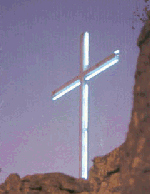
We drove 3000km across our country. And just about every dorp and town has a prominent koppie or ridge with a fluorescent cross planted on it. These are particularly visible to the traveller at night. I suspect that Christian people think this is a way of witnessing to their faith in Jesus….and wonder if the people who erect these Christian symbols ever ask what people of other faiths experience when they see this.
I recently read a letter from Dr Thillayvel Naidoo, a Hindu, who comments as follows about his experience of Christian witnessing:
“Hindus would welcome a display of willingness on the part of Christians to at least begin to understand that others too have a perspective on life that is worthy of much recognition….Surely proselytizing religions will yet reach a stage in history when they will develop the maturity of outlook they lack at present...We hope this means too that disrespectful missionaries from other faiths will stop trying to convert us to their religions.”
I wonder if the towns that display the fluorescent crosses will encourage Muslims, Hindus, Jews and people of other faiths to erect their religious symbols in a lighted form that appropriately matches the Christian crosses.
Wednesday, July 26, 2006
I Don't Understand
I hated mathematics at school - in fact I ducked out of school and went surfing at Glen Beach during the maths lessons. Suffice to say that I don't understand maths. But that does not prevent me from appreciating the symmetry in numbers:
1 x 8 + 1 = 9
12 x 8 + 2 = 98
123 x 8 + 3 = 987
1234 x 8 + 4 = 9876
12345 x 8 + 5 = 98765
123456 x 8 + 6 = 987654
1234567 x 8 + 7 = 9876543
12345678 x 8 + 8 = 98765432
123456789 x 8 + 9 = 987654321
1 x 9 + 2 = 11
12 x 9 + 3 = 111
123 x 9 + 4 = 1111
1234 x 9 + 5 = 11111
12345 x 9 + 6 = 111111
123456 x 9 + 7 = 1111111
1234567 x 9 + 8 = 11111111
12345678 x 9 + 9 = 111111111
123456789 x 9 +10= 1111111111
9 x 9 + 7 = 88
98 x 9 + 6 = 888
987 x 9 + 5 = 8888
9876 x 9 + 4 = 88888
98765 x 9 + 3 = 888888
987654 x 9 + 2 = 8888888
9876543 x 9 + 1 = 88888888
98765432 x 9 + 0 = 888888888
Brilliant!
And finally, take a look at this symmetry:
1 x 1 = 1
11 x 11 = 121
111 x 111 = 12321
1111 x 1111 = 1234321
11111 x 11111 = 123454321
111111 x 111111 = 12345654321
1111111 x 1111111 = 1234567654321
11111111 x 11111111 = 123456787654321
111111111 x 111111111 =12345678987654321
I also don't understand the Creator of life. But that does not prevent me from appreciating the gift of life. And this appreciation keeps me searching for clues about the Originator.
1 x 8 + 1 = 9
12 x 8 + 2 = 98
123 x 8 + 3 = 987
1234 x 8 + 4 = 9876
12345 x 8 + 5 = 98765
123456 x 8 + 6 = 987654
1234567 x 8 + 7 = 9876543
12345678 x 8 + 8 = 98765432
123456789 x 8 + 9 = 987654321
1 x 9 + 2 = 11
12 x 9 + 3 = 111
123 x 9 + 4 = 1111
1234 x 9 + 5 = 11111
12345 x 9 + 6 = 111111
123456 x 9 + 7 = 1111111
1234567 x 9 + 8 = 11111111
12345678 x 9 + 9 = 111111111
123456789 x 9 +10= 1111111111
9 x 9 + 7 = 88
98 x 9 + 6 = 888
987 x 9 + 5 = 8888
9876 x 9 + 4 = 88888
98765 x 9 + 3 = 888888
987654 x 9 + 2 = 8888888
9876543 x 9 + 1 = 88888888
98765432 x 9 + 0 = 888888888
Brilliant!
And finally, take a look at this symmetry:
1 x 1 = 1
11 x 11 = 121
111 x 111 = 12321
1111 x 1111 = 1234321
11111 x 11111 = 123454321
111111 x 111111 = 12345654321
1111111 x 1111111 = 1234567654321
11111111 x 11111111 = 123456787654321
111111111 x 111111111 =12345678987654321
I also don't understand the Creator of life. But that does not prevent me from appreciating the gift of life. And this appreciation keeps me searching for clues about the Originator.
Monday, July 24, 2006
The Dirt on the Mirror
 Telescopes are amazing things. They help us to see that which is unclear with new clarity. The best telescope in the world is SALT, and is to be found at Sutherland, South Africa.
SALT (Southern African Large Telescope) uses mirrors to reflect light from space into a computer. These polymer mirrors are treated to a Kodak polish, and layered with aluminium...all at a cost of R300 000 per mirror. There are 91 of them. And they gradually gather a layer of dust. This is not solved by whipping out a Kleenex, because this would damage the aluminium surface. So every two years they are taken out and the aluminium is replaced. And clarity is restored.
And I thought of St. Paul's idea (2 Cor 3:18) that God's beauty is reflected into our lives. But I know that God's reflection in my life becomes obscured by my self-interest and my fears. I also know that I become used to this dirt. It becomes part of the way I see life, and the way others see me. And then people no longer see God in me, and I lose sight of God.
I am indebted to faithful friends who act as my spiritual maintenance crew: Jenny, Peter, and Kevin are amongst those who confront this dirty mirror with cleansing honesty. And I am grateful.
Thursday, July 20, 2006
Slowly but Surely
 Paternoster caught the scent on the morning breeze. Slowly he moved his head from side to side as he tested the strength of the attraction. Finally he made up his mind. It definitely was female, and he wanted to meet her. So he set off, out of town into the Karoo veldt. The object of his desire lived on the farm of Sheila Snyman, some 10 km outside of Carnarvon. This distance did not deter Paternoster. His attention never wavered, and many days after disappearing from under a bush in town, he arrived at the back door of the farmhouse – determined to meet the new mountain tortoise that Shela had been given. The product of this adventure was Bloukraans. He is a 16 year old mountain tortoise, who has now translocated from Carnarvon to Cape Town.
 We spent the night at “Out of Africa”, a B&B in Carnarvon run by Marie Jacobs. She is hospitable, gregarious, and very helpful (even to posting Jessica's shoes left under the bed. Armed with her directions to Sheila Snyman’s tortoise farm, we set off on a farm road into the veldt. We missed the farm – by 30 km! Eventually the driver (me, male) conceded that we needed to ask directions, and we stopped at a farmhouse where we were put right. The amazingly friendly farmer could not understand why we did not first have a cup of tea before going back along the road to the tortoise farm. But we, the city people, had things to do. We needed to see the tortoises, have lunch at the local café on the square, and get to Douglas. So we declined the offer of tea. Little did we know that we would engage in a leisurely walk among 60 or so tortoises, and then chafe under the unhurried hospitality of the lunch venue.
Sheila Snyman is an expert on Mountain Tortoises, and published the definitive South African Mountain Tortoise book 1987. We learned about their mating habits (the female can store male sperm for up to 4 years), the egg-laying process (they are stored inside the top of the shell while a hole is dug to lay them), and the rings on the shell that denote each year of age (much like a tree). And Sheila gave us Bloukraans, who now has residence under a bush in the back garden.
I was reminded of the story of the tortoise and the hare from Aesop’s Fables: I, from the city, wanted to get through the day. The people of Carnarvon, however, wanted to meet us. The former required time frames and deadlines. The latter asked connecting and building relationships. I, the hare, wanted to get to the goal. Paternoster proved that the tortoise approach can also reach a goal – but with greater texture to the journey.
Subscribe to:
Posts (Atom)


